October 7, 2025
Health Policy Report – October 7, 2025
Virginia Oncology Associates Hosts Site Visit with State Lawmaker

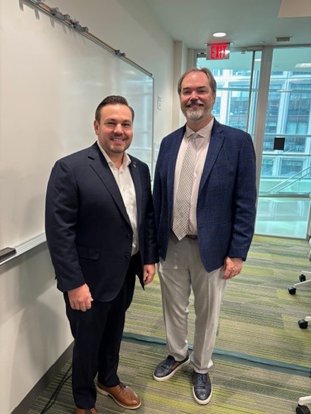
State Senator Saddam Salim toured the Virginia Cancer Specialists Fairfax location with Dr. Anne Favret and Dr. Mitul Ghandi. During this visit, the physicians and staff explained the importance of community oncology and detailed how the practice works with all patients to achieve the best outcomes through providing care close to home with access to clinical trials and lower cost of care. The Senator was particularly appreciative of the practice’s focus on treating all patients and not letting a patient’s healthcare coverage dictate their quality of care. This was an incredible opportunity to highlight the good work our community oncology practices are doing each day.
If you are interested in hosting a site visit with your legislator, please contact Angela Storseth at angela.storseth@usoncology.com
Florida Cancer Specialists Attends Legislative Roundtable
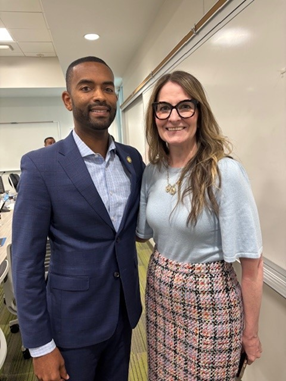
Dr. Richard McDonough from Florida Cancer Specialists recently had the opportunity to engage with major health systems and healthcare provider groups on a State of Florida Healthcare roundtable. The event was hosted by Representative Adam Anderson and Representative Gallop Franklin II and was held at The University of South Florida in Downtown Tampa in September. This is another great example of an opportunity to connect directly with members on issues they are concerned about while also building on the good reputation FCS has in the State of Florida for providing high-quality community cancer care.
White House Announces Deal with Pfizer for MFN Drug Pricing
On September 30, the White House announced an agreement with Pfizer to provide “most favored nation” (MFN) pricing in Medicaid on a direct-to-consumer (DTC) website – dubbed “Trump Rx” – for those paying cash without insurance. The Trump Administration has committed to allow a three-year grace period during which time Pfizer products under a Section 232 investigation won’t face tariffs.
Specific terms of the agreement remain confidential and the exact products available at MFN price to State Medicaid Programs are unclear. Pfizer has committed to onshore 100% of the value of current pharmaceutical imports and announced its intent to invest $70 billion to reshore domestic manufacturing facilities.
There are important limits to the deal, however, as it is not focused on existing drugs for those on Medicare or commercial insurance.
“We’ve established a balanced global pricing approach that continues to recognize the value of innovation while ensuring prices in the U.S. and other developed countries are both reasonable and sustainable, maintaining the strength of the U.S. market alongside other developed nations,” said Pfizer CEO Albert Bourla.
The Trump Administration has also hinted at plans to propose a regulatory process to implement “most favored nation” (MFN) drug pricing for companies that don’t proactively make similar deals.
The Office of Management and Budget (OMB) is reviewing a potential model by the Centers for Medicare & Medicaid Services (CMS) proposed rule titled the “global benchmark for efficient drug pricing (GLOBE) model.” It is unclear from the notice exactly what the proposal will do, but many expect the rule to align with Trump’s 2020 MFN executive order, which focused on reducing Medicare drug prices to match a group of peer countries.
In addition, the Office of Management and Budget (OMB) is currently reviewing a second proposed rule titled the “Guarding U.S. Medicare Against Rising Drug Costs (GUARD) Model.” While the title suggests a focus on Medicare, the scope and details of the proposal have not yet been publicly confirmed.
The ongoing government shutdown could potentially delay the publication of both rules. However, according to guidance from the Office of the Federal Register, rules may still be published during a shutdown if they are certified as “excepted activities”—meaning they are necessary to protect life, property, or the execution of funded functions.
To learn more, CLICK HERE.
Third Round of Medicare Drug Price Negotiations Announced
On September 30, the Centers for Medicare & Medicaid Services (CMS) finalized its guidance for the Medicare Drug Price Negotiation Program’s Initial Price Applicability Year (IPAY) 2028.
The 381-page document outlined how the US government plans to set the prices of an additional 15 drugs in the program. The negotiations for the third cycle are slated to begin in 2026. Negotiated prices are set to take effect in 2028.
The agency updated how it will calculate total expenditures for drugs under Medicare Part B. Additionally, CMS expanded its orphan drug exclusion, allowing more medications with multiple disease indications to avoid price negotiations, per provisions included in the One Big Beautiful Bill Act (OBBBA) passed earlier this year. To qualify for this exclusion, a drug or biological product must be designated as an orphan drug for one or more rare diseases or conditions and have only FDA-approved indications for those designated rare diseases or conditions.
“Today’s guidance will provide Americans with greater access to affordable, life-saving medications while promoting continued investment in new drugs,” Health and Human Services Secretary Robert F. Kennedy, Jr. said in a statement.
To read the full CMS memo, CLICK HERE.
Government Shutdown Begins, Path Forward Remains Unclear
A government shutdown began at midnight on October 1, after Congress failed to pass a stopgap budget. The House narrowly passed a continuing resolution (CR) to keep the government funded, but the Senate failed to pass its version. Senate Democrats are demanding that any continuing resolution include provisions to reverse the Medicaid cuts from earlier this year passed in reconciliation and an extension of Affordable Care Act (ACA) insurance subsidies for low-income Americans, which are set to expire at the end of the year.
While a shutdown has sweeping effects across the country, many functions of the government have not been immediately affected. Programs like Medicare and Medicaid – whose recipients will continue to receive benefits – will likely be unaffected by the shutdown, for now. However, disease surveillance, support from the Centers for Disease Control and Prevention (CDC) to local and state health departments, and funding for health programs will all be hampered in the immediate term.
The Department of Health & Human Services (HHS) is expected to furlough about 40% of its workforce. The Trump administration has also threatened mass layoffs across government agencies.
A bipartisan group of Senators has met to discuss a potential compromise on the ACA tax credits, but a potential path forward remains unclear.
To learn more, CLICK HERE.
Hospitals Push Back as Trump Administration Moves Forward with Site Neutral Policies
The American Hospital Association (AHA) is pushing back on the Trump administration’s proposal to more closely align payment for physicians with hospitals for the same services. This summer, the Centers for Medicare & Medicaid Services (CMS) issued its Physician Fee Schedule (PFS) and Hospital Outpatient Prospective Payment System (HOPPS) proposed rules, which would include site neutral payments for drug administration.
In its comments on the proposed rules, AHA argued that, if finalized, such a change would “fundamentally rewrite the law” on hospital payment and that the administration is not authorized to do so. If the policy moves forward, AHA is anticipated to challenge the Trump administration in court.
Physicians and patient groups, however, largely support such measures. In its comments to the agency, the American Medical Association (AMA) urged CMS to reinvest any savings into Medicare physician payments.
The proposed rule has already been submitted to the Office of Management and Budget (OMB) for review, indicating that its official publication could be approaching. Historically, CMS has released the final rule in early November, with policies taking effect on January 1 of the following year.
To learn more, CLICK HERE.