March 24, 2026
Health Policy Report – March 24, 2026
Dr. Randy Drosick Testifies Before Ohio House Insurance Committee

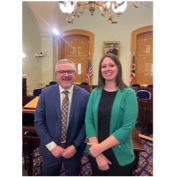
On March 17, Randy Drosick, MD, Practice President at Oncology Hematology Care (OHC), traveled to Columbus, Ohio, to testify before the Ohio House Insurance Committee in support of SB 682, which aims to prevent white bagging mandates in the physician office setting.
During his testimony, Dr. Drosick outlined how white bagging mandates present real-world challenges for patients, including delayed care, increased waste, concerns about drug shipping and handling, and higher out-of-pocket costs despite payer claims of savings.
Dr. Drosick addressed the committee’s questions about OHC’s current in-office drug administration process, emphasizing how it allows the practice to safely adjust doses based on a patient’s status. Following the hearing, Dr. Drosick met one-on-one with several committee members to further discuss the negative impact of white bagging on patients and community oncology practices.
To view Dr. Drosick’s testimony (beginning at 21:00), CLICK HERE.
Dr. Debra Patt Speaks on Value of Community Oncology


Debra Patt, MD, PhD, MBA, Executive Vice President of Policy and Strategic Initiatives at Texas Oncology, recently represented the oncology community in several high‑profile panels focused on policy, access, and innovation in healthcare. Along with Texas State Representative James Frank and other stakeholders, Dr. Patt participated in a Texas Conservative Coalition Research Institute (TCCRI) discussion on the 340B Drug Pricing Program. During the conversation, Dr. Patt highlighted that the 340B program has grown exponentially and raised healthcare costs, without demonstrated improvements in access to care for the low-income population it was intended to serve.
Dr. Patt also joined collaborators from Cencora and Blue Cross Blue Shield (BCBS) in a Drug Channels Institute forum, heightening awareness of how physician-administered drugs provide more Americans with access to cutting-edge, affordable cancer care. The discussion highlighted how well-intended policies, including 340B and the Inflation Reduction Act, threaten to undercut innovation and access to care.
Finally, Dr. Patt participated in an Axios panel where she discussed the role of health in the media, including how to strengthen science, public health, and health literacy – all of which can help patients navigate their care journey. Across all three panels, Dr. Patt elevated the perspective of community-based oncology and the importance of policies that protect patient access to high‑quality cancer care.
GOP Considers Second Reconciliation Push
After a GOP leadership retreat, Republican members of Congress have signaled their intent to work on a second reconciliation package before the midterm elections. While Speaker Mike Johnson (R-LA) and other key leaders have expressed optimism about a potential package, some House members – including Jason Smith (R-MO), Chairman of the House Committee on Ways & Means – appear skeptical about the path forward, particularly given the thin Republican House majority.
The health policies that would be included in a potential reconciliation remain unclear, though some Republicans have discussed targeting fraud, waste, and abuse – a key priority of the Trump administration.
To read more, CLICK HERE.
House Energy & Commerce Health Subcommittee Holds Hearing on Healthcare Affordability
On March 18, the House Energy & Commerce Health Subcommittee held the third hearing in a series on healthcare affordability. The latest hearing, titled “Lowering Health Care Costs for All Americans: An Examination of the U.S. Provider Landscape,” featured Rick Pollack, the CEO of the American Hospital Association (AHA), and David Aizuss, the board chair of the American Medical Association (AMA), among others.
During the hearing, lawmakers focused on the role of insurers and drugmakers in elevating healthcare costs. Additionally, Representatives Diana Harshbarger (R-TN), Morgan Griffith (R-VA), and Buddy Carter (R-GA) scrutinized the 340B Drug Pricing Program, noting that misaligned incentives under the program are driving up drug prices. Chairman Morgan Griffith (R-VA) framed the hearing around patient access and affordability challenges driven by provider market consolidation, noting that “hospitals are acquiring physician practices, systems are merging, and too often, patients have little options among providers.”
Representative Neal Dunn, M.D. (R-FL) highlighted the pressures facing independent physicians, including cuts to reimbursement for Medicare Part B drug administration under the Inflation Reduction Act (IRA). Representative Dunn specifically called on his fellow lawmakers to advance H.R. 4299, the Protecting Patient Access to Complex and Cancer Therapies Act, which would make a technical fix to the IRA, stabilizing reimbursement for Medicare Part B drugs and ensuring lower costs for patients.
To watch the hearing, CLICK HERE.
Trump Administration Considers Plans to Expand MFN Drug Pricing
As part of its focus on healthcare affordability ahead of the midterm elections, the Trump administration is looking to ramp up efforts to expand and codify the administration’s most-favored-nation (MFN) drug pricing deals reached with several drug manufacturers.
The White House has been urging Congress to advance MFN legislation that would bring the cost of medications to levels below what similarly developed countries pay. However, lawmakers have yet to embrace this proposal, with many Republicans concerned that such a policy would run counter to the free-market principles conservatives have traditionally embraced.
While exact next steps remain unclear, senior officials in the White House have recently noted that the administration will renew its push and provide a more specific policy blueprint to codify MFN policies similar to those reached with drug manufacturers. One senior official recently said that the administration expects to begin negotiating additional, voluntary MFN deals with drugmakers starting in April.
The Network will continue to monitor these developments closely to ensure that such proposals do not interfere with practices’ ability to provide care.
MedPAC Recommends Increase to Physician Payment
In its March report to Congress, the Medicare Payment Advisory Commission (MedPAC) recommended Medicare physician pay increase by an additional 0.5% in 2027. However, it backed away from previous recommendations to link annual updates to a measure of inflation called the Medicare Economic Index (MEI).
“In the commission’s view, this recommendation for 2027 strikes an appropriate balance between the need to provide adequate payments to clinicians and the need to limit growth in beneficiaries’ cost sharing and premiums and maintain financial pressure on clinicians to constrain their costs,” the report reads.
Physician groups, including the AMA, welcomed the recommendation to increase reimbursement next year and urged policymakers to enhance the sustainability of the Medicare system by linking future updates to inflation. “MedPAC should continue urging Congress to link physician payment updates to MEI to provide stability for physician practices and certainty for patients. Other health care providers have payments linked to inflation, which spares them the annual year-end scramble in Congress to fend off payment cuts,” said Dr. Bobby Mukkamala, President of the AMA, in a statement.
To read more, CLICK HERE.
To read MedPAC’s full report, CLICK HERE.
To read the AMA’s statement, CLICK HERE.
Democratic Lawmakers Seek Clarity on MFN Models
In a letter sent to many of the pharmaceutical companies that reached MFN deals with the White House, Senate Finance Committee ranking Democrat Ron Wyden (D-OR) and Senators Amy Klobuchar (D-MN), John Hickenlooper (D-CO), Elizabeth Warren (D-MA), Dick Durbin (D-IL), Jeff Merkley (D-OR), and Christopher Murphy (D-CT) requested clarity on whether drugs covered by the deals are exempt from the GENErating cost Reductions fOr U.S. Medicaid (GENEROUS) Model. The lawmakers asked for more details about how pharmaceutical companies will apply MFN pricing to Medicaid programs if they plan to do so outside of the GENEROUS model.
The companies have until March 23 to respond to the lawmakers’ inquiry.
The letter is part of a larger effort by Democratic lawmakers to learn more about the MFN agreements struck with pharmaceutical companies, as many details have not been made public. Earlier this month, the House and Senate Democratic Health Committee leaders requested copies of the agreements from the Trump administration. “As Ranking Members of the committees with jurisdiction over health care, we write to request copies of the most-favored-nation agreements that you struck with pharmaceutical companies and have kept hidden from Congress and the American people,” the letter read.
To read one of the letters sent to pharmaceutical companies, CLICK HERE.
To read the letter to the Trump administration, CLICK HERE.