September 23, 2025
Health Policy Report – September 23, 2025
Trump Administration Signals Growing Interest in Most Favored Nation Policies
Discussions about most favored nation (MFN) drug pricing policies are ongoing in Washington, following the Trump Administration’s Executive Order on the topic this spring. Administration allies failed to get their most-favored nation policy in Republicans’ reconciliation package earlier this year. However, the administration continued to hint that they plan to use executive authority to try to force drugmakers to offer U.S. patients the lower drug prices they offer in Europe and Canada.
In the meantime, Congress is considering how the basics of such a policy would work. In a briefing held by Arnold Ventures, the Cato Institute, and the American Enterprise Institute, congressional staff – largely from Republican offices – explored the precedents of other countries’ drug price controls, tradeoffs, and potential issues with implementation.
Meanwhile, on Monday, September 22, Bristol Myers Squibb (BMS) announced their plans to launch COBENFY, a schizophrenia drug, in the U.K. at the U.S. list price. BMS in their release noted that, “this approach underscores President Trump’s call for other countries to pay their fair share for American innovation.”
The Trump Administration has signaled that it will announce concrete steps on MFN this fall. The Network is actively tracking these discussions and closely monitoring developments.
To read more, CLICK HERE.
The US Oncology Network Holds Annual Fly-In
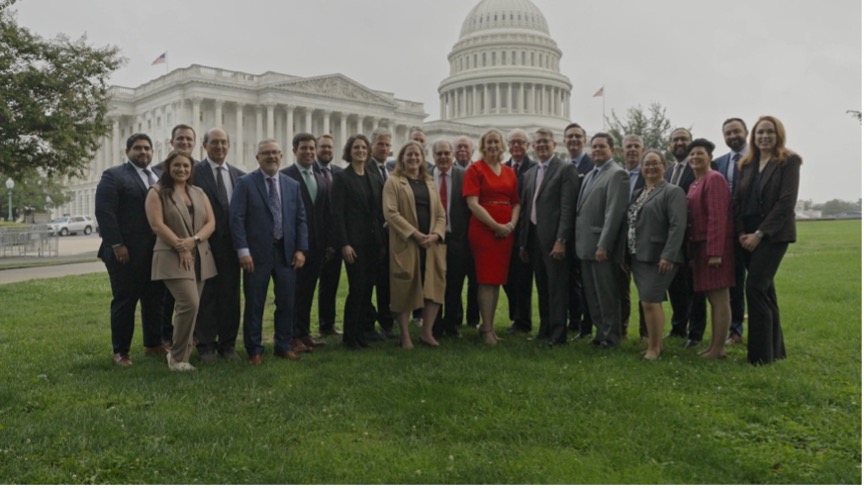

On September 16 and 17, The US Oncology Network held its surgeon’s and PAC Board fly-in in Washington, DC. During the events, physician advocates met with over 20 federal lawmakers, including several who hold key positions on the House Energy and Commerce and Ways & Means Committees. The Network’s physicians discussed the importance of the Protecting Patient Access to Cancer and Complex Therapies Act (H.R. 4299) and Seniors’ Access to Critical Medications Act (H.R. 2484), both of which would protect patients’ convenient access to life-saving cancer therapies in their communities. The Network also discussed the need to advance broad site neutral payment reform, a critically important step to help stem the tide of consolidation and lower costs for patients.
The Network thanks the physician advocates in attendance and looks forward to continuing our advocacy at the state and federal level.
To read H.R. 4299, CLICK HERE.
To reach H.R. 2484, CLICK HERE.
The Network Submits Comments on PFS and HOPPS Proposed Rules
The Network recently submitted comments to the Centers for Medicare and Medicaid Services (CMS), addressing the proposed CY 2026 Medicare Physician Fee Schedule (PFS) and Hospital Outpatient Prospective Payment System (HOPPS) rules.
The Network commended the agency’s action to better align payments between independent practices and hospitals. “This policy represents a critical advancement toward site-neutral payment reform and a more level playing field for all providers, aligning with our commitment to efficient, patient-centered care in independent practices,” The Network wrote.
The Network also expressed the need for long-term inflation-tied Medicare payment reform to ensure a sustainable physician reimbursement system. “While we support the modest increase to the proposed 2026 PFS conversion factor that was long overdue, we call for a long-term solution that would tie future payments to inflation, possibly utilizing the Medicare Economic Index (MEI),” the letter reads.
Further, The Network reiterated concerns with the incorporation of Maximum Fair Price (MFP) for drugs selected under the Inflation Reduction Act (IRA) into the calculation of the manufacturer’s Average Sales Price (ASP) effective January 1, 2026. The Network stressed the need for CMS to revisit this policy and for Congress to advance the Protecting Patient Access to Cancer and Complex Therapies Act (H.R. 4299), which would help preserve the financial viability of physician practices while still achieving cost savings.
CMS will now review the comments submitted by stakeholders and will release the final rule later this fall, typically around November.
To read the Network’s MPFS comments, CLICK HERE.
To read the Network’s HOPPS comments, CLICK HERE.
Congress Divided on How to Fund Government as Shutdown Looms
With time running out to fund the federal government after September 30, concerns are growing around Washington that a shutdown is increasingly possible. House Republicans passed a relatively “clean” continuing resolution that would keep the government running through November 21, while lawmakers negotiate a longer-term appropriations deal. The House Republican proposal would extend important Medicare telehealth and hospital-at-home flexibilities, extend Medicare-dependent Hospital and low-volume adjustment programs, and delay Medicaid Disproportionate Share Hospital cuts.
Meanwhile, House and Senate Democrats have staked out a very different position, releasing their own funding proposal on September 17. Instead of a clean continuing resolution, Democrats would also like to extend the Affordable Care Act’s Advance Premium Tax Credit, which are set to expire at the end of the year. The proposal would also reverse Medicaid cuts enacted in President Trump’s signature One Big Beautiful Bill Act, restore federal funding that has been frozen by the administration, and increase oversight to ensure appropriated funds are spent as Congress intended—all provisions that are extremely unlikely to garner Republican support. The Democrats’ proposal, which would fund the government through October 31, would likely cost hundreds of billions of dollars. Senate Majority Leader Chuck Schumer (D-NY) and House Democratic Leader Hakeem Jeffries (D-NY) are expected to meet with President Trump this week to try to come to an agreement.
To avert a government shutdown, any continuing resolution must overcome the Senate filibuster threshold, which requires at least 60 votes. Without bipartisan support, the resolution would stall procedurally, increasing the likelihood of a shutdown.
To read more, CLICK HERE.
To read the bill text of the Republican proposal, CLICK HERE.
To read the bill text of the Democratic proposal, CLICK HERE.
Report Shows Rise in 340B Spending
A recent report from the Congressional Budget Office (CBO) examined the growth in drug purchases made through the 340B Drug Pricing Program from 2010 to 2021. The report found that in this time period, 340B spending grew 19 percent annually, across all facilities participating in the 340B Prime Vendor Program.
In addition to market wide trends of increased drug spending, the report suggests that the growth in 340B spending may be attributed to the integration of hospitals and off-site clinics, increased facility participation after the implementation of the Affordable Care Act and expanded use of off-site pharmacies.
The CBO also posits that the 340B program encourages abusive behaviors – including incentivizing the prescription of more expensive drugs and reducing negotiated rebates for insurers – that tend to increase federal spending and raise prices for American taxpayers.
Thankfully, Representatives Earl “Buddy” Carter (R-GA) and Diana Harshbarger (R-TN) recently introduced the 340B Affording Care for Communities and Ensuring a Strong Safety-Net Act (340B ACCESS Act). If passed, this legislation would improve patient outcomes by establishing oversight and transparency of the 340B program and providing achievable solutions to ensure the program is used for good. The Network will continue to monitor the progress of the 340B ACCESS Act.
To read the report, CLICK HERE.
GAO Publishes New Report on Physician Consolidation
A new report from the Government Accountability Office (GAO) shows that fewer doctors are working in independent or private practices. Instead, the review found more physicians are consolidated under large hospital systems. According to the report, physician practices have “increasingly been acquired by hospital systems, insurance companies, private equity firms, and other entities.”
The GAO found that estimates of hospital-physician consolidation show at least 47 percent of doctors were employed by or affiliated with hospital systems in 2024, up from less than 30 percent in 2012, citing a study by the American Medical Association.
The agency noted that private equity ownership of or investment in physician practices represents a small but growing share of physicians nationally, about 6.5% in 2024.
Studies reviewed by the GAO suggest that this consolidation can lead to increased spending and higher prices for insurers, including increased costs for traditional Medicare. However, the GAO found mixed results for the effect of per-patient costs for commercial insurance.
To read the report, CLICK HERE.
U.S. Appeals Court Rejects IRA Challenge from Novartis
The biopharmaceutical industry lost yet another legal battle following a ruling from the U.S. Court of Appeals for the Third Circuit. The court unanimously rejected the challenge presented by Novartis against the Inflation Reduction Act’s (IRA) Medicare Price Negotiation Program. The ruling comes after several similar losses for drug manufacturers including Johnson & Johnson, Bristol Myers Squibb, AstraZeneca, and others. While this leaves the potential for a Supreme Court appeal as a final option, fourteen decisions have now upheld the government’s ability to negotiate drug prices, with none siding with manufacturers.
Research from the National Pharmaceutical Council and the University of Washington show that the IRA is already changing the way investors look at pharmaceutical investment. With 87% of life-science investors stating that they believe the law will make it harder to bring innovative drugs to market. Of those interviewed, 77% of investor say the IRA’s “pill penalty” has created a disincentive to invest in small molecules. This study builds on previous research highlighting the unintended consequences of the IRA when it comes to patients’ access innovative treatments.
To read more, CLICK HERE.
To read the study, CLICK HERE.