August 25, 2026
Health Policy Report – August 25, 2026
Dr. Michael Burgess Pens Op-Ed in Support of H.R. 4299 in Real Clear Health
Former Congressman Michael Burgess, M.D. (R-TX) recently penned an op-ed in Real Clear Health advocating for Congress to pass the Protecting Patient Access to Cancer and Complex Therapies Act (H.R.4299). As a physician and former Chair of the House Energy and Commerce Health Subcommittee, Dr. Burgess has been a vocal advocate for independent physicians and formerly sponsored this legislation in the 118th Congress.
In his op-ed, Dr. Burgess outlined the consequences that the Inflation Reduction Act’s Medicare Part B reimbursement changes will have on access to care. “But the real impact is on patients. When independent practices cannot sustain care, patients do not stop needing treatment. Patients could be pushed into hospital systems, where care is often more expensive and less convenient. For patients in rural or underserved communities, it may mean longer travel, delays in treatment, or going without care altogether,” he wrote.
Dr. Burgess highlighted that Congress now has an opportunity to swiftly pass this bill. “Fixing this issue now, before these policies are fully implemented, is far easier than trying to rebuild access after it has been lost. This is preventative medicine at its best. Once community practices scale back or shut down, they are difficult, if not impossible, to replace.”
To read his full op-ed, CLICK HERE.
In New Podcast, Dr. Leslie Busby Highlights Role of Advocacy in Community Oncology
In a new episode of Put into Practice, the podcast for the JCO Oncology Practice, Dr. Leslie Busby spoke about advocacy in oncology and what community oncologists can do to safeguard access to local care. During the interview, Dr. Busby elaborated on his article, “Importance of Physician Advocacy in the Fight to Protect Local Cancer Care,” which was co-authored with Dr. Rupesh Parikh of Comprehensive Cancer Centers of Nevada and published in JCO – Oncology Practice.
Dr. Busby highlighted how he got involved in community oncology, his experience working in independent practice, and the importance of building long-term relationships with lawmakers at all levels of government. He concluded by encouraging his fellow physicians to contribute to Political Action Committees (PACs), write letters to their lawmakers, and begin to reach out to their representatives.
To listen to the podcast, CLICK HERE.
Dr. Mark Saunders Pens LTE in Support of H.R. 4299
In a letter to the editor in the print edition of the Tyler Morning Telegraph, Dr. Mark Saunders of Texas Oncology thanked Congressman Nathaniel Moran (R-TX) for co-sponsoring the Protecting Patient Access to Cancer and Complex Therapies Act (H.R. 4299).
Dr. Saunders emphasized the importance of access to community-based care for Texans living with a cancer diagnosis. “Over 160,000 Texans will be diagnosed with cancer this year. To help them survive, access to community-based care is critical,” he wrote.
He went on to describe how the Inflation Reduction Act will reduce payments to community oncology clinics for select treatments, threatening their financial stability and patient access to care. Dr. Saunders emphasized the need for lawmakers to advance H.R. 4299 and ensure that community-based care remains an option for patients.
“I’m grateful to U.S. Rep. Nathaniel Moran of TX-01 for co-sponsoring H.R. 4299, which would protect local cancer care. This bill isn’t just common sense; it makes fiscal sense. H.R. 4299 would save patients $93.3 billion in lower premiums and cost-sharing and save the government $71.3 billion,” he concluded.
To read the LTE, CLICK HERE.
Minnesota Oncology Site Visit with Caleb Sebora, Director of Outreach, Office of Congresswoman Kelly Morrison, M.D.
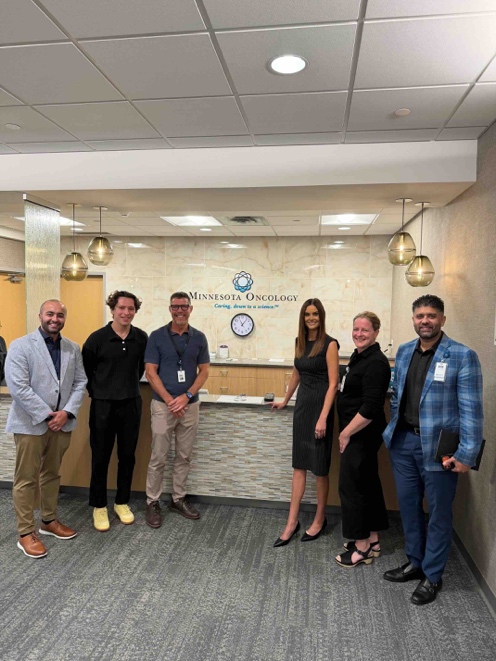
Minnesota Oncology recently hosted Caleb Sebora from the Office of Representative Kelly Morrison, M.D., at its Maple Grove clinic. During the visit, Minnesota Oncology leaders – Dr. Amy McNally, Dr. Paul Thurmes, Raghav Nayyar, Executive Director at Minnesota Oncology, and Kirollos Hanna, Director of Pharmacy at Minnesota Oncology – highlighted how the practice supports patients across the full continuum of cancer care, from diagnosis and treatment planning to infusion therapy, hematology, supportive services, clinical trials, and ongoing follow-up. With multiple locations across the Twin Cities metro area, Minnesota Oncology allows patients to receive advanced cancer care closer to home while staying connected to the care teams and support systems that guide them throughout their treatment journey.
The conversation centered on several federal policy priorities directly tied to patient access and the sustainability of community oncology. Leaders discussed the Protecting Patient Access to Cancer and Complex Therapies Act (H.R. 4299), which would address Medicare Part B reimbursement challenges tied to drug price negotiation, as well as the Seniors’ Access to Critical Medications Act (H.R. 2484), which would restore medically integrated dispensing flexibilities for oral cancer medications.
Together, these policy discussions reinforced how reimbursement stability, medication access, and sustainable physician payment updates are critical to helping independent practices continue delivering the full continuum of cancer care in lower-cost community settings.
If your practice is interested in hosting a site visit, please contact Angela Storseth at angela.storseth@usoncology.com.
Texas Oncology Meets with State Senator Lois Kolkhorst
Texas Oncology recently met with State Senator Lois Kolkhorst to discuss the value of community oncology and the importance of ensuring patients can access high-quality cancer care close to home. During the meeting, practice leaders highlighted how community oncology practices deliver convenient, lower-cost care while maintaining strong patient outcomes.
As Chair of the Senate Committee on Health and Human Services, Senator Kolkhorst plays a key role in shaping legislation affecting patients and physicians across Texas. Texas Oncology and The Network look forward to continuing to work with Senator Kolkhorst on policies that protect access to community-based cancer care.
The Network Supports Letter-Writing Campaign to Advance the Protecting Patient Access to Cancer & Complex Therapies Act (H.R. 4299)
In partnership with the Patient Access to Community Treatment (PACT) Coalition, The Network is supporting a letter-writing campaign to advance the Protecting Patient Access to Cancer & Complex Therapies Act (H.R. 4299) in California, Illinois, Nevada, New Jersey, New York, Pennsylvania, and Texas.
An unintended flaw in how Medicare Part B drug price negotiations are structured under the Inflation Reduction Act (IRA) threatens severe reimbursement reductions for provider add-on payments. Because physician reimbursement is calculated as a percentage of the drug’s price, negotiating lower drug prices creates a sharp shortfall that fails to cover the real-world overhead costs of acquiring, storing, handling, and safely administering complex therapies.
Without a technical fix, independent specialty practices and community infusion centers will face unsustainable financial pressure—forcing clinic closures, reduced services, or shifts of patient care into higher-cost hospital settings.
H.R. 4299 introduces a targeted, bipartisan technical fix. It shifts the financial adjustment to a manufacturer rebate model, ensuring independent providers are adequately reimbursed while preserving Medicare’s negotiated savings and protecting patient out-of-pocket costs.
The Network is reaching out to practices in target states so that clinic leaders can participate in the letter-writing campaign and voice their support for H.R. 4299.
The US Oncology Network’s State Policy Team Attends the National Conference of State Legislatures (NCSL)

The US Oncology Network’s State Government Relations team recently attended the National Conference of State Legislatures (NCSL) Annual Summit in Chicago, Illinois. The annual conference brings together thousands of state legislators, legislative staff, and policy stakeholders from across the country, creating a unique opportunity to engage directly with policymakers on issues impacting patients and providers.
Through The Network’s exhibit booth, our team showcased the critical role independent community oncology practices play in delivering high-quality, accessible, and cost-effective cancer care. The summit provided valuable opportunities to engage with state legislators from across the country, discuss policy issues affecting cancer patients and community-based providers, and share perspectives from practices within The Network. These conversations help build relationships, increase awareness of the challenges facing community oncology, and advance policies that protect patient access to local cancer care close to home.
Major PBMs Agree to Offer Trump Rx Pricing Information
On August 13, ten pharmacy benefit managers (PBMs) announced a partnership with the White House’s TrumpRx website. The agreement will allow patients to see the prices from their PBM plan alongside the direct-to-consumer price listed on TrumpRx.
“By making negotiated drug prices available alongside cash prices on TrumpRx, this agreement will give patients greater visibility into how much (patients are) paying and help them find the best possible deal,” Oz explained. “That’s the kind of transparency we need to boost competition, drive down costs, and deliver better value for American patients.”
To read more, CLICK HERE.
Prescription Drug Prices Record Sharpest Drop in 60 Years
Prescription drugs are experiencing a significant price deflation, recording the largest drop over a year in six decades. As healthcare costs continue to rise overall, the recent Consumer Price Index revealed that prescription drug prices fell 0.8% this July and 3.1% over the past year.
This trend is likely explained by a number of factors, including TrumpRx, the administration’s website for discounted cash prices on certain drugs, the Medicare drug price negotiation, and a wave of blockbuster drugs that have lost patent protection, resulting in increased availability of lower-cost, generic drugs.
To read more, CLICK HERE.
Congress Returns to a Short Calendar and a Long To-Do List
Congress is set to return after Labor Day with 16 legislative days left in the House and 14 in the Senate before the midterm elections, which means leadership will focus almost entirely on must-pass items.
FY26 funding to keep the federal government open expires at midnight on October 1. The House and Senate left town in August with competing stopgap funding bills and now arrive back in DC with the final funding agreement up in the air. A stopgap through early December is the likeliest outcome, with the FY27 National Defense Authorization Act (NDAA), the Farm Bill, and most other policy issues pushed to a lame duck session.
The limited number of legislative days remaining before the elections increases the likelihood that congressional leaders will focus on a narrower scope of must-pass items, while other priorities are deferred until after the midterm elections. How lawmakers navigate these issues over the next few months will shape both the legislative outlook for the remainder of the 119th Congress and the policy environment entering 2027.