June 16, 2026
Health Policy Report – June 16, 2026
Drs. Busby and Parikh Author JCO-OP Article on Physician Advocacy
Dr. Les Busby, Chief Medical Officer of The US Oncology Network, and Dr. Rupesh Parikh, Practice President of the Comprehensive Cancer Centers of Nevada, recently authored an article on the importance of physician advocacy in the Journal of Clinical Oncology – Oncology Practice.
“Physician voices matter, whether engaging with industry partners or professional society political action committees, writing or calling elected officials, or participating in policy discussions,” they wrote. Drs. Busby and Parikh stressed that engagement with local, state, and federal lawmakers through site visits, Days at the Capitol, and other advocacy activities is key to preserving patient access to high-quality cancer care.
They went on to highlight recent policy successes in Texas and Nevada, where physicians successfully pushed back against regulatory and insurance barriers.
If your practice is interested in hosting a site visit or participating in a Day at the Capitol, please contact Angela Storseth at angela.storseth@usoncology.com.
To read Dr. Busby and Dr. Parikh’s full article, CLICK HERE.
Network Physicians Author LTEs and Op-Eds in Support of H.R. 4299
On the heels of The Network’s fly-in in Washington, D.C., Network physicians have authored letters to the editors and op-eds in their local newspapers thanking their representatives for their support of the Protecting Patient Access to Cancer and Complex Therapies Act (H.R. 4299).
In an LTE in the Bucks County Herald, Dr. Moshe Chasky of Alliance Cancer Specialists thanked Representative Brian Fitzpatrick (R-PA) for co-sponsoring the legislation. “Community cancer care is critical for Pennsylvania patients and families. Representative Fitzpatrick recognizes this, and I encourage him to continue working with his colleagues to pass this legislation as quickly as possible,” he wrote.
In the Citrus County Chronicle, Dr. David Wenk of Florida Cancer Specialists & Research Institute applauded Representative Gus Bilirakis (R-FL) for supporting the legislation, noting that it’s a “practical, bipartisan solution that protects patients and reduces healthcare spending.”
Similarly, in the Odessa American, Dr. Pankaj Khandelwal of Texas Oncology highlighted that this legislation was needed to protect local access to care in a “state as big as ours” and thanked Representative August Pfluger (R-TX) for his work to advance the bill.
Dr. Balesh Sharma outlined similar sentiment in an op-ed in the Brownsville Herald. He wrote that “independent clinics are often the only realistic option for treatment in South Texas. Local oncology practices allow many patients in the Valley to receive care close to home instead of traveling to San Antonio, Houston, or beyond.” Dr. Sharma thanked Representative Vicente Gonzalez (D-TX) for recognizing these benefits and co-sponsoring H.R. 4299.
If you are interested in writing a letter to the editor in your local newspaper, please reach out to Angela Storseth at angela.storseth@usoncology.com.
To read Dr. Chasky’s LTE, CLICK HERE.
To read Dr. Wenk’s LTE, CLICK HERE.
To read Dr. Khhandelwal’s LTE, CLICK HERE.
To read Dr. Sharma’s op-ed, CLICK HERE.
MOH Hosts Site Visit with State Senator Alonzo Washington
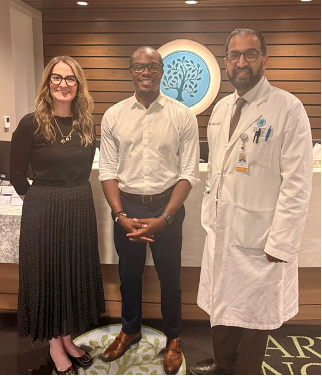
On June 5, Maryland Oncology Hematology (MOH) hosted a site visit with State Senator Alonzo Washington at their White Oak location in Silver Spring, Maryland. Dr. Kashif Firozvi, an oncologist and hematologist at MOH’s Silver Spring location and the Director of Cancer Services at White Oak Medical Center, led a thoughtful tour and discussion with Senator Washington.
Dr. Firozvi described the role that community oncology plays in the healthcare system, the extensive services and access to care MOH provides to its patients, the connections the practice has with its partners, and the importance of those working relationships on patient care, as well as highlighting some policy challenges that patients and providers experience daily.
Dr. Firozvi highlighted the practice’s capabilities, including medically integrated dispensing, targeted radiation therapy, and a newly opened on-site Next Generation Sequencing (NGS) Lab. All of these are reminders of the highly personalized level of care and access to innovative treatments that are available and provided by community oncologists each day.
We are grateful to Senator Washington for taking time to visit, listen, and engage with providers and staff at MOH and look forward to working with him in the future.
If your practice is interested in hosting a site visit, please contact Angela Storseth at angela.storseth@usoncology.com.
Trump Administration Releases Interim Final Rule for Medicaid Work Requirements
On June 1, the Centers for Medicare & Medicaid Services announced an interim final rule that will require most Medicaid beneficiaries between the ages of 19 and 64 to prove that they work, complete community service, or participate in a work program to receive benefits.
The new rule gives states some flexibility in determining exemptions. For example, states can determine who is “medically frail,” but they will need to verify the presence of a condition or diagnosis and confirm that the condition of diagnosis significantly impairs the individual’s ability to comply with the work requirements.
The decision comes after Congress passed the One Big Beautiful Bill Act last summer, which included significant cuts to the Medicaid program. Trump administration officials argue that work requirements are needed to root out fraud, waste, and abuse in the Medicaid program. State officials, however, are arguing that these new requirements will generate significant implementation costs.
The work requirements will begin on Jan. 1, 2027.
To read the interim final rule, CLICK HERE.
To read more, CLICK HERE.
House Passes Anti-Fraud Bills
The House of Representatives recently passed a series of anti-fraud measures. The
On June 8, the House Committee on Rules held a markup and advanced three bills targeting fraud prevention through accountability and reform efforts: the Fraud Prevention and Accountability Act (H.R. 8312), the Stopping Fraudulent Payments Act (H.R. 8464), and House Resolution 1335.
These bills would institute varying anti-fraud efforts, including establishing an Inspector General for Fraud, Accountability, and Recovery (IGFAR), increasing the government’s authority to pause suspicious payments, and condemning actors defrauding the US.
The full House later passed these bills, marking the latest in a series of efforts from the administration and Congress to root out fraud in Medicaid.
To watch the markup, CLICK HERE.
To read about the full House vote, CLICK HERE.
President Trump Nominates HHS Assistant Secretary Focused on Hospital Finance Reform
On June 1, President Trump nominated Ge Bai to serve as an Assistant Secretary for the Department of Health and Human Services (HHS).
Bai is currently the Principal Deputy Assistant Secretary for Planning and Evaluation at HHS. She has previously testified in front of congressional committees on hospital financing and has been a vocal advocate to reduce drug spending and advance hospital transparency reform.
If confirmed as Assistant Secretary for HHS, Bai would serve in a high-level advisory role to HHS Secretary Robert F. Kennedy Jr.
To read more, CLICK HERE.
CMS Releases Final IDR Rule
On May 28, the Trump administration released a final rule to streamline and strengthen the No Surprise Act’s Independent Dispute Resolution (IDR) process. The No Surprises Act was intended to promote fair contracting incentives for physicians and insurers through the IDR process. However, many health plans have undermined this process, creating administrative burden for independent practices.
The final rule would reduce the administrative fee for disputes from $115 to $15, which officials argue will make it easier for physicians to participate in the process. The final rule also included provisions to streamline and strengthen the dispute process, including the development of a new online tool that will allow users to initiate a dispute, track the status of open cases, and manage other activities.
To read the rule, CLICK HERE.
To read more, CLICK HERE.