May 19, 2026
Health Policy Report – May 19, 2026
The US Oncology Network Hosts Congressional Briefing and PAC Board Fly-In
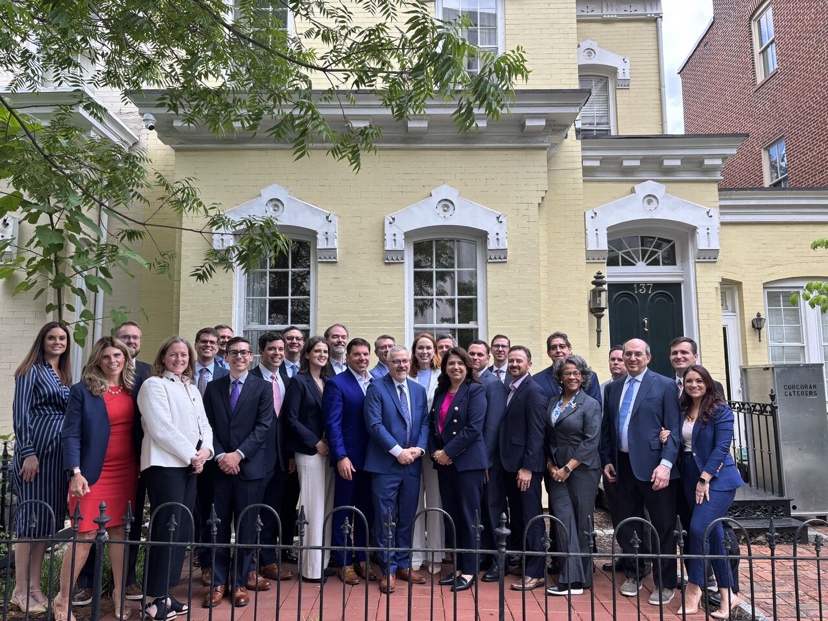
On May 13, The US Oncology Network hosted a congressional briefing on the real-world impact of Medicare Part B drug reimbursement changes on patients and independent physicians.
The briefing featured a panel of physicians, including Dr. Debra Patt, President of the Community Oncology Alliance and Executive Vice President of Texas Oncology, Dr. David Spigel, President and Chief Medical Officer of Sarah Cannon Research Institute and Medical Oncologist with SCRI Oncology Partners, Dr. Jennifer Gordon, Gynecologic Oncologist at Willamette Valley Cancer Institute, and Devon Womack, President of The US Oncology Network.
Physician panelists discussed how the Inflation Reduction Act’s changes to Medicare Part B drug reimbursement threaten patient access, practice viability, and clinical innovation and advocated for lawmakers to advance the Protecting Patient Access to Cancer & Complex Therapies Act (H.R. 4299). The bill’s sponsor, Representative Greg Murphy, M.D. (R-NC), discussed how the legislation can provide a targeted fix that helps alleviate the pressures independent practices face today.
Devon Womack, President of The US Oncology Network and Ben Jones, Senior Vice President, Marketing and Government Relations, also provided remarks.
The Network built on this momentum by hosting its PAC Board fly-In the next day, where 25 physicians met with more than 35 lawmakers to discuss the pressures facing independent medicine.
The Network thanks the physician advocates in attendance and looks forward to continuing our advocacy at the state and federal level.
To read more, CLICK HERE.
To read more in POLITICO Influence, CLICK HERE.
Presidents Send a Letter to Congressional Leadership, Urge Support for H.R. 4299
On May 11, practice presidents of The US Oncology Network wrote to congressional leadership, urging the House to advance the Protecting Patient Access to Cancer and Complex Therapies Act (H.R. 4299) and urging Senate leadership to reintroduce the Senate companion legislation.
In their letter, practice presidents outlined the anticipated impact of the Inflation Reduction Act’s changes to Medicare Part B drug reimbursement. “Absent a statutory fix, these reductions would push reimbursement below sustainable levels for community oncology practices, which must acquire, store, handle, and administer complex therapies. This places physicians squarely in the middle of manufacturer negotiations,” they wrote.
The letter went on to highlight how the Protecting Patient Access to Cancer & Complex Therapies Act can avoid these unintended consequences, while generating significant cost savings for patients and the Medicare program.
“These findings demonstrate that Congress can fulfill the intent of the Medicare Drug Price Negotiation Program without dismantling the community oncology care delivery system that a majority of Medicare cancer patients depend on. At the core, this needed legislative solution seeks to mitigate the pending disruption to community oncology providers across the country,” the letter read.
To read the letter, CLICK HERE.
To read more, CLICK HERE.
Dr. Joseph Muscato, Missouri Cancer Associates, Authors LTE in the Jefferson City News Tribune
Dr. Joseph Muscato recently penned a letter to the editor (LTE) in the Jefferson City News Tribune highlighting how Missouri HB 3170 would jeopardize access to local cancer care. Lawmakers are currently considering the bill, which would remove antitrust laws to allow the University of Missouri health system to expand, giving it a competitive advantage over independent providers.
Dr. Muscato emphasized that this bill, if passed, would create an imbalance of market power, allowing large health systems to acquire rural facilities and centralize care, raising costs for patients and taxpayers alike.
”Missouri should focus on strengthening rural health care access by supporting a range of providers and care settings, rather than making it easier for care to become concentrated in one system. Rural Missourians do need strong, sustainable care options, but those options should be built in a way that keeps care accessible, affordable, and centered on patient choice,” Dr. Muscato concluded.
To read the LTE, CLICK HERE.
Dr. Richard Ingram, Shenandoah Oncology, Pens LTE in the Richmond Times-Dispatch
Dr. Richard Ingram, medical oncologist and hematologist at Shenandoah Oncology and President of the Virginia Association of Hematology Oncology (VAHO), recently authored a letter to the editor (LTE) in the Richmond Times-Dispatch urging Virginia Governor Abigail Spanberger to veto SB 271 and HB 483, which create a prescription drug affordability board to cap drug costs.
As written, the bill risks lowering payments to community oncology clinics to the point that they fall below the cost of providing care. In his LTE, Dr. Ingram expressed concern that this provision could create new barriers for patients seeking to access local cancer care.
“Community practices like mine must purchase, store, prepare, and administer expensive therapies before reimbursement. Policies ignoring these real costs put practices in an unsustainable position, leading to fewer services, reduced options, consolidation and patients shifted to costlier hospital systems,” he wrote.
Dr. Ingram urged Governor Abigail Spanberger to veto the legislation and allow further time for input from physicians, pharmacists, and practices on how to lower costs while improving access to care.
“Affordability matters greatly — but does the proposal cut patient costs or just shift burdens while risking access? Virginia should target true drivers like insurance design and pharmacy benefit managers, not unproven policies promising savings that may never reach patients,” he concluded.
To read the LTE, CLICK HERE.
Comprehensive Cancer Centers of Nevada Opens New Center

On May 12, Comprehensive Cancer Centers of Nevada (CCCN) held a ribbon-cutting ceremony for its new center in downtown Las Vegas. Las Vegas Mayor Shelley Berkley was in attendance at the ceremony, alongside other city and county officials.
The downtown practice, which marks CCCN’s eighth location, has been seeing patients since April 29.
During the event, CCCN announced its new collaboration with Sarah Cannon Research Institute, which will allow patients to enroll in clinical trials and expand their treatment options.
“This flagship location represents our continued commitment to ensuring that patients have access to innovative, high-quality cancer care close to home,” said Dr. Rupesh J. Parikh, practice president and medical oncologist at Comprehensive. “Our roots in the Las Vegas Medical District show our genuine commitment to growing this hub for clinical excellence, education and research.”
Blue Ridge Cancer Care Recognized by Virginia General Assembly
The Virginia General Assembly recently passed a resolution recognizing Blue Ridge Cancer Care (BRCC) for its contributions to the Commonwealth.
“The General Assembly hereby commend Blue Ridge Cancer Care for its legacy of service on the occasion of its 50th anniversary,” the resolution read.
The resolution was introduced by State Senator Travis Hackworth, who represents the 5th District of Virginia, made up of Bland County, Giles County, Pulaski County, Smyth County, Tazewell County, Radford City, as well as portions of Montgomery County, and Wythe County. State Senator Hackworth recently visited BRCC’s Blacksburg office.
To read the resolution, CLICK HERE.
Texas Oncology Celebrates Groundbreaking of Novartis RLT Center


On May 7, leaders from Texas Oncology attended a groundbreaking ceremony for Novartis’ new radioligand therapy (RLT) manufacturing site in Denton, Texas. The site will become fully operational in 2028 and produce radioligand therapies for patients, including those served by Texas Oncology.
“It’s been unbelievable results. What we’re seeing is these patients have advanced metastatic prostate cancer, they have failed other therapies and they’re looking for another opportunity and so we’re able to insert this radiopharmaceutical into their regimen, which has a very limited impact on their quality of life and we’re seeing good outcomes. It’s really a win-win,” said radiology oncologist Dr. Michael Herman, of Texas Oncology.
U.S. Undersecretary of Commerce for Industry and Security Jeffrey Kessler, Texas State Senator Brent Hagenbuch, Texas State Representative Andy Hopper, and Denton Mayor Gerard Hudspeth were also in attendance.
To read more, CLICK HERE.
To read a press release, CLICK HERE.
FDA Leadership in Flux as Dr. Makary Resigns
On May 12, Dr. Marty Makary resigned as Commissioner of the Food and Drug Administration (FDA) after a tenure marked by significant upheaval. During his 13 months at the helm of the FDA, Dr. Makary made controversial decisions on mRNA vaccines and rare disease drug rejections.
President Trump announced that Kyle Diamantas, the current Deputy Commissioner for Food, would serve as the acting commissioner of the FDA until the Senate confirms a replacement.
In addition to his work overseeing the Human Foods Program, Diamantas has served as a critical liaison between the FDA, Department of Health and Human Services, and the White House since joining the administration in February 2026.
Prior to that, he was a corporate lawyer at Jones Day and Baker Donelson, helping clients navigate food regulation. Under the Vacancies Act, Diamantas can serve as acting FDA commissioner with limited responsibilities for 210 days until a permanent nominee is confirmed.
To read more, CLICK HERE.
To read more about Kyle Diamantas, CLICK HERE.
Real Clear Health Op-Ed Shines Light on Changes to Medicare Part B Drug Reimbursement
On May 6, Real Clear Health published an op-ed urging Congress to pass the Protecting Patient Access to Cancer and Complex Therapies Act (H.R. 4299).
In their op-ed, the authors, Dr. Chris Phillips, an American College of Rheumatology leading rheumatologist, and Dr. Martin Palmeri, a Fellow of the American Society of Clinical Oncology, highlighted how changes to Medicare Part B drug reimbursement under the Inflation Reduction Act could destabilize small, independent practices. These changes could cause reimbursements to plummet by as much as 61%, according to one study by Avalere Health.
By passing H.R. 4299, Drs. Phillips and Palmeri argue that Congress can “remove independent clinics from the middle of the price negotiation occurring between the government and the drug manufacturer and ensure that a well-intentioned initiative to reduce drug costs does not backfire by harming patient access.”
To read the full op-ed, CLICK HERE.
The Wall Street Journal Editorial Board Urges Congress to Curb 340B Program
On May 8, the Wall Street Journal published an editorial, entitled, “The Great 340B Healthcare Grift,” highlighting concerns with the 340B Drug Pricing Program. The editorial argues that many hospitals have used the program to generate substantial revenue rather than directly lowering costs for patients, while Congress has provided limited oversight of how the savings are used.
The editorial board called for reform to increase accountability and ensure savings are passed on to patients.
“If Republicans in Congress want to reduce healthcare costs, they’ll use their next budget reconciliation bill to curb this 340B abuse—say, by requiring hospitals and pharmacies to pass along the discount money to patients. This is government grift at its worst,” the editorial board concluded.
White House Announces Drug Pricing Deals May Save $529 Billion Over 10 Years
The Associated Press recently obtained an analysis by the White House Council of Economic Advisers toplining projected savings that could be realized by the United States under the administration’s most favored nation (MFN) drug policy.
The analysis highlighted $529 billion in prospective savings over the next decade as more drugs come onto the market and are impacted by the policy. This includes an estimated $64.3 billion in savings for drugs covered under Medicaid. One model in the researchers’ framework could generate as much as $733 billion over the next 10 years.
Democrats and many other stakeholders remain skeptical about these potential savings. To date, the specific terms of the deals the White House has reached with pharmaceutical companies have not been made public, and some reports have suggested that savings may not be passed down to consumers.
To read more, CLICK HERE.